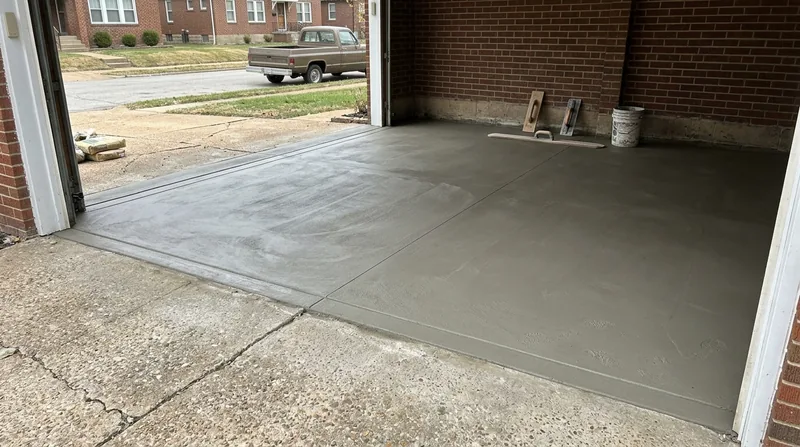




St. Louis homeowners face a unique set of concrete challenges, from freeze-thaw cracking on winter streets to settlement caused by the region's silty loess and clay soils sitting above limestone bedrock. A garage floor in St. Louis takes a beating from road salt tracked in on tires, oil drips from vehicles, moisture seeping up from the water table, and the constant weight of cars and storage. Whether you're building a new garage addition in a 1950s brick ranch in Kirkwood, replacing a failed slab in a Central West End Victorian, or pouring a fresh floor for a subdivision home in Chesterfield, a properly finished and sealed concrete garage floor is not a luxury, it's a foundation investment. We pour and finish garage slabs that resist cracking, staining, and moisture intrusion, so your floor stays level and clean for decades. This guide covers why garage floors matter in St. Louis, how we build them, what they cost, and what to look for when hiring a contractor near you.
Why Garage Floors Matter in St. Louis: Settling Soil and Salt Damage
St. Louis sits on a foundation of clay, silt, and limestone that doesn't stay put. Karst sinkholes in parts of the region, old clay-mine fill in neighborhoods like parts of south city, and soft river-bottom soil near the Missouri and Meramec cause slabs to settle, sink, and crack. Winter freeze-thaw cycles push moisture into cracks, expanding the damage season after season. Road de-icing salt tracked into garages scales and pits unprotected concrete, while oil and transmission fluid stain bare slabs permanently. A sealed garage floor stops this damage before it starts.
- Prevents moisture from wicking up through the slab and damaging vehicles, tools, and stored items.
- Resists oil, transmission fluid, and battery acid stains that accumulate over years of vehicle use.
- Stops freeze-thaw scaling caused by winter salt and repeated wet-dry cycles in our climate.
- Stays level longer because proper grading and base preparation account for local soil settlement patterns.
- Reduces cracking from the stress of vehicles parked on an uneven or improperly finished slab.
A well-built garage floor protects your investment and keeps your garage usable year-round, even as the St. Louis soil shifts beneath it.
Key info: St. Louis County and City homes built before 1980 often sit on uncontrolled fill or settling clay. If your garage floor is cracking or pooling water, the soil beneath may be moving. We inspect the slab, assess drainage, and build new floors with proper slope and base preparation to handle local conditions.
For more information on how soil and foundation issues affect concrete work in St. Louis, visit the City of St. Louis Building Division or consult our concrete slabs and foundations page for details on base preparation and site evaluation.
How We Build Garage Floors in St. Louis: Site Prep, Concrete, and Finishing
A durable garage floor starts long before the concrete is poured. We evaluate drainage, remove old slab if needed, compact the base, set proper slope toward drains or exits, and finish the surface to resist wear and staining. The entire process takes 5 to 7 days from excavation to cure, depending on weather and slab size. Summer heat speeds concrete set time, so we pour early in the day and protect fresh concrete from the afternoon sun and thunderstorms common to St. Louis springs.
- We excavate and remove any old cracked or failed slab, haul debris, and prepare a clean base.
- We compact the subgrade and install 4 to 6 inches of compacted gravel base to support the new slab and manage water.
- We set up forms, check for proper slope (typically 1/8 inch per foot toward exit or drain), and position reinforcement mesh or rebar.
- We pour 4-inch concrete, finish with a smooth steel trowel or a non-slip broom finish for traction.
- We cure the slab for 7 days before applying a penetrating sealer that resists oil, moisture, and salt staining.
The finished floor is ready for vehicles, storage, and the daily wear of a working garage in St. Louis.
Real example: A homeowner in Webster Groves had a 400-square-foot garage with a 1970s slab that was settling and cracking. We removed the old floor, compacted new base, poured a 4-inch slab with proper slope toward the garage door, finished it smooth, and sealed it. Two years later, no new cracks, no stains, and the floor is level. That's the St. Louis standard we deliver.
Learn more about our concrete finishing techniques and sealing options on our concrete sealing page.
Garage Floor Methods and Finishes: Choosing the Right Approach
| Approach | Description | Best For |
|---|---|---|
| Smooth Trowel Finish | Steel-troweled surface, polished or left matte, shows footprints and dust but easy to sweep and mop. | Garages where appearance and easy cleaning matter; homes in Creve Coeur or Clayton where aesthetics count. |
| Broom Finish | Textured surface created with a broom, provides traction, hides dirt and tire marks, less slippery when wet. | Working garages, tool shops, and homes where safety and low maintenance are priorities; common in Chesterfield and St. Charles County. |
| Sealed Finish | Penetrating or topical sealer applied after cure, protects against oil, water, salt, and UV damage, extends floor life by years. | All St. Louis garages; essential for freeze-thaw climates and homes with road salt exposure from winter driving. |
| Removal and Replacement | Complete demo of failed slab, new base prep, and pour; fixes settlement, drainage, and structural issues. | Older St. Louis homes with sunken or severely cracked floors; Florissant and O'Fallon homes on clay fill or karst zones. |
Each method has a role in St. Louis garages. We recommend sealed finishes for all new work because our climate and salt exposure demand it.
Garage Floors Cost in St. Louis: What to Expect
Garage floor pricing in St. Louis starts at approximately $5 per square foot for a standard 4-inch concrete slab with basic site prep and finish. A typical two-car garage of 400 to 500 square feet runs $2,000 to $2,500 for materials and labor. The final cost depends on several factors specific to your home and lot. Removal of an old slab adds $1 to $2 per square foot. Poor soil conditions or difficult drainage can increase base preparation costs. Sealing adds $0.50 to $1.50 per square foot but is essential in St. Louis and pays for itself by preventing staining and freeze-thaw damage. Access constraints (tight alleys in Soulard or Lafayette Square, or steep driveways on the private streets of the Central West End) may require hand-digging or smaller equipment, raising labor costs by 15 to 25 percent.
We always recommend getting two or three estimates from insured contractors in your area. This shows you the range of pricing and approach, and helps you understand what's included. Visit our pricing page for a detailed breakdown by service type and job size, then request a free estimate tailored to your specific garage and site.
Garage Floors Near Me: What to Look for When Hiring a Concrete Contractor in St. Louis
Hiring the right contractor means checking credentials, understanding what's covered, and making sure the job is done right the first time. Insurance and workers compensation coverage are non-negotiable. Always ask for a certificate of general liability insurance and workers compensation proof before work begins. This protects you if anyone is injured or property is damaged during the job. Get multiple estimates, check references from past garage floor jobs, and ask to see photos of completed work in similar St. Louis homes or neighborhoods. Understand whether your job requires a permit from the City or County, and confirm that your contractor will handle permit applications and inspections if needed. If you live in an HOA community in Ballwin, Maryland Heights, or Wildwood, check your covenants and restrictions for any requirements on garage appearance or construction methods.
- Request proof of general liability and workers compensation insurance on every estimate and before any work starts.
- Ask for three references from garage floor jobs completed in the past two years in St. Louis or St. Louis County.
- Confirm whether a permit is required and who is responsible for obtaining and paying for it.
- Get the estimate in writing, including scope, materials, timeline, and total cost with no surprises.
- Verify that sealing is included or clearly priced as an add-on, because it is essential in our climate.
A contractor who is transparent about insurance, provides references, and explains the work in detail is one you can trust to deliver a floor that lasts.
Ready to move forward? Contact us today for a free, no-obligation estimate at (314) 916-1279. We respond within 24 hours and serve all of St. Louis and surrounding areas.
Garage Floors in St. Louis: Pricing Guide
| Service | Price | Details |
|---|---|---|
| Standard Garage Floor (4-inch slab, basic finish) | Starting at $5/sq ft | Includes site prep, concrete pour, smooth or broom finish, typical 400-500 sq ft garage runs $2,000-$2,500 |
| Slab Removal and Replacement | Starting at $6-$7/sq ft | Adds demo, debris haul, and new base prep; necessary for failed, sunken, or severely cracked existing slabs |
| Sealing (Penetrating or Topical) | $0.50-$1.50/sq ft | Applied after cure; essential in St. Louis for freeze-thaw protection, oil stain resistance, and long-term durability |
| Difficult Site Access or Poor Soil | On estimate | Hand-digging, tight alleys, clay fill, or karst zones require site inspection before pricing; labor costs increase 15-25 percent |
| Travel and Estimate | Free | No charge for travel within St. Louis and surrounding counties; free estimate within 24 hours at (314) 916-1279 |
Indicative pricing, the exact cost depends on square footage, finish, and site access. Free personalized estimate within 24h at (314) 916-1279.


