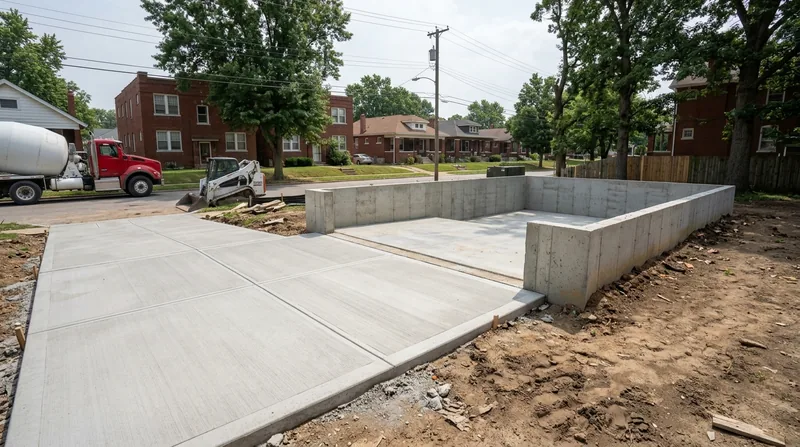




Concrete slabs and foundations in St. Louis face a unique challenge: the region sits on silty loess and clay over limestone, with old clay-mine fill and soft river-bottom soil near the Missouri and Meramec that cause settling, cracking, and structural movement over time. Freeze-thaw cycles, road salt, and heavy spring thunderstorms accelerate deterioration on driveways and walks across the city's tight Victorian rowhouses in Soulard and Lafayette Square, the brick bungalows of St. Louis Hills, and the sprawling ranch and two-story subdivisions of St. Louis County and St. Charles County. A properly engineered slab with steel reinforcement and a compacted base is not optional here, it's the difference between a stable foundation that lasts decades and one that settles, cracks, and fails within years. We pour concrete slabs and footings for garages, sheds, room additions, and new construction with the thickness, reinforcement, and site preparation that this climate and soil demand. Call St. Louis Concrete at (314) 916-1279 for a free, no-obligation estimate.
Why Concrete Slabs & Foundations Matter in St. Louis: Soil Settlement and Freeze-Thaw Damage
St. Louis soil is notoriously unstable. The silty loess and clay base shifts seasonally, and karst sinkholes in parts of the region create unpredictable subsidence. Freeze-thaw cycles in winter, combined with road de-icing salt and spring flooding, accelerate cracking and spalling on exposed concrete. A slab poured on an improperly compacted or inadequate base will sink, crack, and fail, especially in neighborhoods like Benton Park, Tower Grove South, and along the river bottoms near Arnold and Wentzville where the soil is softest.
- We compact the base layer to engineered density to prevent settling and differential movement.
- We specify reinforcement (rebar or wire mesh) to resist the tensile stresses that freeze-thaw and soil movement create.
- We pour to the thickness required by local code and the load (residential, garage, or addition) to ensure long-term stability.
- We finish and slope the surface for proper drainage so water does not pool and accelerate deterioration.
A solid slab foundation stops settlement, cracking, and the cascade of structural problems that follow.
Key info: In neighborhoods with known clay-mine fill or river-bottom soil (parts of The Hill, near the Meramec, and scattered throughout St. Charles County), a pre-pour soil test and engineered design are often necessary. We work with local engineers to confirm compaction and thickness before we pour.
For more on how concrete fails and how to prevent it, see our concrete repair and resurfacing page. If your slab has already settled, we also offer concrete leveling and slab lifting.
How We Pour Concrete Slabs & Foundations in St. Louis: A Step-by-Step Process
Every slab begins with site preparation. We excavate to the correct depth, remove soft or unsuitable material, and compact the subgrade in layers to the density specified by local code or an engineer. We then set forms, install reinforcement (rebar, wire mesh, or both), and pour the concrete to the specified thickness and slope. Finishing includes troweling, brooming for traction on exterior slabs, and proper curing to develop full strength. The entire process takes 7 to 14 days from excavation to full cure, depending on slab size, weather, and intended use.
- We call the city to locate utilities and obtain any required permits for the slab before we break ground.
- We excavate and compact the base in layers, testing density to ensure it meets local standards and will not settle.
- We set and level forms, install reinforcement at the correct spacing and depth, and check elevation before pouring.
- We pour concrete to the specified thickness, finish the surface, and slope it for drainage away from structures.
- We protect the slab from rain and rapid drying for 7 days to allow proper cure and strength development.
The result is a stable, durable foundation that resists St. Louis's soil movement, freeze-thaw stress, and weather for decades.
Example: A homeowner in Kirkwood needed a new garage foundation after their existing slab developed a 2-inch settlement crack along the back edge. We excavated, found soft clay fill, compacted and stabilized the subgrade, poured a 5-inch slab with #4 rebar at 18 inches on center, and finished it with a 1 percent slope to the front. The new slab is now stable and will not settle or crack.
See our garage floors page for more on foundation slabs for garages and accessory buildings.
Concrete Slab & Foundation Methods: Choosing the Right Approach
| Method | Description | Best For |
|---|---|---|
| Poured concrete slab on grade | Excavate, compact base, pour reinforced concrete 4 to 6 inches thick, finish and cure on site. | Garages, sheds, patios, garage additions, and any structure on stable or improved soil. |
| Engineered footing with stem wall | Pour a deeper footing below frost line (36 to 48 inches in St. Louis), then build an above-grade stem wall for crawlspace or basement entry. | Room additions, new construction, and areas with known settlement or frost-heave risk. |
| Post-tensioned slab | High-strength cables are tensioned within the concrete to counteract differential settlement and cracking over time. | Large or complex foundations, areas with severe soil instability, and structures where cracking must be minimized. |
| Monolithic slab | Footing and slab are poured as a single pour, with the perimeter thickened to support load. | Residential garages and simple additions where frost protection and load-bearing are moderate. |
Each method is chosen based on soil conditions, frost depth, building code requirements, and the load the slab must support. We assess your site and recommend the approach that will provide the longest service life.
Concrete Slabs & Foundations Cost in St. Louis: What to Expect
Concrete slab and foundation pricing in St. Louis starts at $5 to $8 per square foot for a basic on-grade slab with standard reinforcement and finishing. A 400-square-foot garage slab typically runs $2,000 to $3,200. Engineered footings with stem walls, post-tensioned slabs, and sites requiring soil remediation or extensive base preparation cost more. Access, soil conditions, and whether you need a permit engineer to sign off on the design all affect the final price.
The most common cost drivers are:
- Soil conditions and base preparation: soft or unsuitable fill requires removal and replacement, adding $1 to $3 per square foot.
- Reinforcement: standard wire mesh costs less than rebar, and post-tensioning adds $2 to $4 per square foot.
- Frost protection and depth: footings below frost line cost more than shallow on-grade slabs.
- Finishing: broom finish is standard; trowel finish or decorative options add cost.
- Permits and engineering: most residential slabs do not require a permit engineer, but complex or large additions often do.
Get 2 to 3 estimates before you decide. Each contractor will assess your soil, code requirements, and site access differently, and prices will vary. A low estimate might skip proper base preparation or reinforcement, leading to cracking and settlement later. A detailed estimate breaks down labor, materials, and base prep so you know what you are paying for.
For a full pricing breakdown by slab type and region, see our pricing page.
What to Look for When Hiring a Concrete Contractor Near Me in St. Louis
Choosing the right concrete contractor protects your investment and ensures your slab lasts. Start by asking for proof of general liability insurance and workers compensation coverage. A contractor without insurance puts you at legal and financial risk if someone is injured on your property or if damage occurs during the pour. Request a certificate of insurance before work begins and verify it is current.
Get multiple estimates and ask each contractor to explain their base preparation method, reinforcement plan, and finishing approach. A contractor who cuts corners on subgrade compaction or skips reinforcement may save money upfront but will leave you with a slab that cracks and settles within a few years. Ask for references from recent slab jobs in your neighborhood (Kirkwood, Webster Groves, Chesterfield, Florissant, St. Charles, St. Peters, or O'Fallon) and call at least two to confirm quality and timeline.
If your project requires a permit (common for room additions and new construction), confirm that your contractor will handle the application and that the work will pass inspection. Understand your HOA rules if you live in a deed-restricted community. Some neighborhoods have design or material restrictions, and your contractor should know them before starting.
Ready to move forward? Contact us for a free estimate at (314) 916-1279. We respond within 24 hours and come to your site to assess soil, code requirements, and access before we quote.
Concrete Slabs & Foundations in St. Louis: Pricing Guide
| Service | Price | Details |
|---|---|---|
| On-grade slab, standard reinforcement | Starting at $5/sq ft | 4 to 5 inch slab with wire mesh, compacted base, broom finish, includes labor and standard materials |
| Engineered footing with stem wall | Starting at $12/sq ft | Footing below frost line, stem wall above grade, rebar reinforcement, site-specific soil testing and compaction |
| Post-tensioned or complex slab | On estimate | Severe soil settlement, large building addition, or structural requirements demand site assessment and engineer design |
| Base preparation and soil remediation | Starting at $2/sq ft | Removal and replacement of unsuitable fill, compaction testing, and engineered subgrade stabilization add to slab cost |
| Travel and site visit | Included | No mileage fee or call-out charge for St. Louis, Kirkwood, Webster Groves, Chesterfield, Florissant, and surrounding areas |
| Free estimate | No obligation | Response within 24 hours at (314) 916-1279, includes site inspection, soil notes, and written quote |
Indicative pricing, the exact cost depends on square footage, finish, and site access. Free personalized estimate within 24h at (314) 916-1279.


